
At the AI Impact Summit in New Delhi, Prime Minister Narendra Modi calls for human-centric use of technology
India Unveils ‘MANAV Framework’ for AI Governance

- আপডেট সময় : ০২:০২:৩৭ অপরাহ্ন, শনিবার, ২১ ফেব্রুয়ারী ২০২৬
- / ৫৮৬ বার পড়া হয়েছে
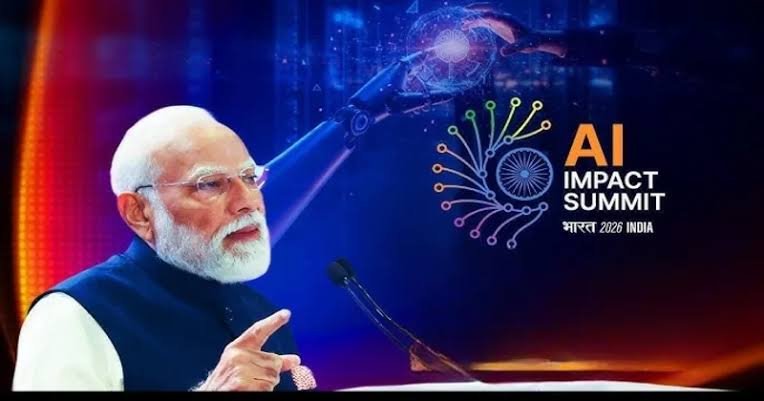
International Desk: At a defining moment in human history, the AI Impact Summit brought together world leaders, policymakers, and innovators to shape the future of Artificial Intelligence (AI). Hosted in New Delhi, the summit marked a proud milestone for India as the country presented the ‘MANAV Framework’—a human-centric ethical governance model for AI.
Indian Prime Minister Narendra Modi said, “India always brings scale and energy to whatever it undertakes, and this summit was no exception.” With participation from over 100 countries, including innovators and youth delegates, the event became one of the world’s largest and most inclusive AI gatherings.
“Throughout human history, technological shifts—from fire and writing to electricity and the internet—have reshaped civilization. AI is another such revolution, but its impact can now unfold globally within weeks,” the Prime Minister said.
Emphasizing a people-first approach, Modi noted, “AI must work for the welfare of humans, not the other way around.”
Based on this principle, India introduced the MANAV Framework, a moral foundation for AI governance that ensures ethical, transparent, and inclusive technological development:
M – Moral and Ethical Systems: Building AI on ethical and value-based principles
A – Accountable Governance: Ensuring transparency and accountability
N – National Sovereignty: Protecting nations’ rights over their own data
A – Accessible and Inclusive: Making AI open and equitable for all
V – Valid and Legitimate: Ensuring AI remains lawful and verifiable
Modi highlighted that AI should complement, not replace, human capabilities. He cited India’s progress in applying AI across agriculture, security, language inclusion, and social welfare.
He mentioned examples such as AMUL’s ‘Sarlaben’, an AI-powered digital assistant that provides 3.6 million women dairy farmers with real-time guidance on livestock health and productivity in their own languages. Similarly, the ‘Bharat Vistaar’ platform empowers farmers with multilingual insights on weather, markets, and crop management.
“Just as food products carry nutrition labels, digital content must also carry authenticity labels,” Modi said, urging the global community to establish shared standards to combat misinformation and deepfake threats.
Highlighting the importance of accessibility, he added, “Technology achieves its greatest potential when it is shared, not hoarded.” To empower India’s youth, the government has launched extensive skilling and reskilling programs designed for the AI era.
Under the India AI Mission, thousands of GPUs have already been deployed to provide affordable computing power for startups and researchers. A National AI Repository has also been created to democratize access to datasets and AI models.
“India’s diversity, democracy, and demographic strength make it uniquely positioned for inclusive innovation,” Modi said. “Solutions that work in India can serve humanity everywhere.”
He concluded with an invitation to the world: “Design and Develop in India, Deliver to the World, Deliver to Humanity.”
নিউজটি শেয়ার করুন
আপলোডকারীর তথ্য